Selelekela
Thank you for choosing Kanto UKI 100W Active Desktop Computer Speakers. These speakers are designed to provide an elevated audio experience for your music, games, and movies, featuring seamless connectivity and intelligent subwoofer integration. This manual will guide you through the setup, operation, and maintenance of your new speakers.

Kanto UKI Speakers: Shaped by nature, tuned for balance.
Se ka Lebokoseng
- Kanto UKI Active Desktop Computer Speakers (2 units)
- Mohala oa Matla
- Mohala oa sebui
- Tataiso ea ho Qala ka Potlako
Likarolo tsa Sehlahisoa
- Molumo o Nonneng: Bi-amplified design delivering 100W to 3" woofers and ¾" silk dome tweeters for smooth mids and airy highs.
- Khokahano e Seamless: USB-C, Bluetooth, and RCA inputs for versatile device connection.
- Intelligent Sub Integration: Automatically routes frequencies below 100 Hz to a connected subwoofer for balanced, full-range sound.
- Everyday Ease of Use: Intuitive controls, including a front-mounted control knob for volume, input switching, and power. Stereo orientation can be flipped for convenience.
- Compact, Stylish Design: Space-saving form factor with various color options to complement any workspace.

Key features of Kanto UKI speakers.
Tlhophiso
1. Ho Beha Sebui
Place the active speaker (with controls and inputs) on your preferred side (left or right). The passive speaker connects to the active speaker via the included speaker wire. For optimal sound, position speakers at ear level and equidistant from your listening position.

Kanto UKI speakers integrated into a desktop workspace.
2. Ho hokahanya Libui
Connect the active speaker to the passive speaker using the provided speaker wire. Ensure correct polarity (positive to positive, negative to negative) for optimal audio performance.

Rear panel of Kanto UKI speakers with connection ports.
3. Khokelo ea Matla
Connect the power cord to the active speaker and then to a wall outlet.
4. Audio Source Connection
The Kanto UKI offers multiple input options:
- USB-C: Connect your computer or laptop using a USB-C cable for high-quality digital audio.
- Bluetooth: For wireless connection, refer to the 'Operating Instructions' section for pairing.
- RCA: Use RCA cables to connect analog audio sources.
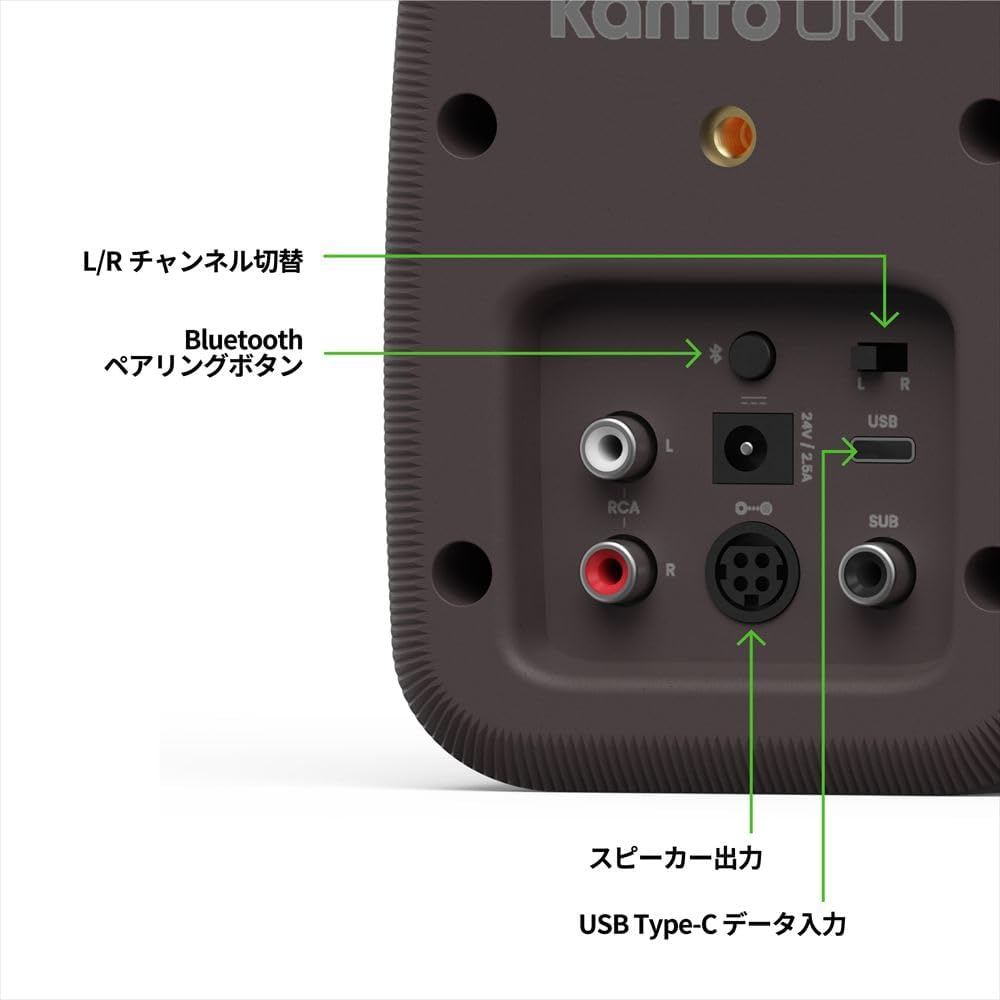
Ka botlalo view of Kanto UKI connectivity options.
5. Subwoofer Integration (Optional)
If you wish to add a subwoofer, connect it to the 'SUB OUT' port on the active speaker. The UKI speakers will automatically route frequencies below 100 Hz to the subwoofer, optimizing the sound profile.

Kanto UKI speakers with an optional subwoofer.
Litaelo tsa Ts'ebetso
1. Matla a ho tima / ho tima le ho laola molumo
Use the front-mounted control knob on the active speaker to turn the speakers on or off and adjust the volume.
2. Khetho ea ho kenya
Press the control knob to cycle through the available inputs (USB-C, Bluetooth, RCA).
3. Bluetooth pairing
- Select Bluetooth input using the control knob.
- On your device, search for 'Kanto UKI' in the Bluetooth settings and select to pair.
- The LED indicator on the speaker will confirm successful pairing.
4. Stereo Orientation
A switch on the rear of the active speaker allows you to flip the stereo orientation (Left/Right) to ensure the headphone output and controls are always within easy reach, regardless of speaker placement.

Adjusting stereo orientation for convenience.
5. Sehlahisoa sa li-headphone
Connect your headphones to the front-mounted headphone jack for private listening. The speakers will automatically mute when headphones are connected.
Tlhokomelo
1. Ho hloekisa
Wipe the speaker cabinets with a soft, dry cloth. Avoid using harsh chemicals or abrasive cleaners, as they may damage the finish.
2. Tlhokomelo e Akaretsang
Keep the speakers away from direct sunlight, heat sources, and moisture. Ensure adequate ventilation around the speakers to prevent overheating.
Ho batle phoso
Ha ho Modumo
- Ensure the speakers are powered on and the volume is turned up.
- Check all cable connections (power, speaker wire, audio source).
- Verify the correct input source is selected on the speakers.
- Haeba o sebedisa Bluetooth, etsa bonnete ba hore sesebediswa se arotswe mme se haufi le sebaka seo se ka sebediswang ho sona.
- If headphones are connected, disconnect them to enable speaker output.
Molumo o sothehileng
- Fokotsa molumo ho libui le mohloli oa molumo.
- Check for loose or damaged cables.
- Ensure the audio source is not overdriving the speakers.
Mathata a ho Kopanya Bluetooth
- Ensure the speakers are in Bluetooth pairing mode.
- Forget the device from your Bluetooth settings and attempt to re-pair.
- Move your device closer to the speakers to ensure it is within range.
Litlhaloso
| Sebopeho | Lintlha |
|---|---|
| Mofuta oa ho Beha | Sebui sa Khomphutha |
| Lintho tse bonahalang | Plastiki |
| Lebitso la Mohlala | UKIDSBB |
| Mofuta oa Sebui | Sebui sa Khomphutha |
| Tšobotsi e Khethehileng | 100W Peak Power (50 Watts Total RMS), 3" Paper Cone Drivers, 3/4" Silk Dome Tweeters, 80 Hz - 22 kHz Frequency Response, Class D Bi-Ampmoqhobi |
| Litšebeliso tse khothalelitsoeng | Ka hare |
| Lisebelisoa tse lumellanang | Desktop, Kanto SU2 |
| Palo ea likarolo | Palo ea 1.0 (Para) |
| Potoloho ea Mohala oa Molumo o Potileng | 2.0 |
| Mmala | Pumice |
| Kenyellelitsoe Likaroloana | Power Cord, Quick Start Guide, Speaker Wire, Speakers x 2 |
| Litekanyo tsa Sehlahisoa | 4.3"D x 4.4"W x 6.5"H |
| Boima ba Ntho | 1.9 lik'hilograma (lik'hilograma tse 4.18) |
| Mofuta oa Warranty | Moedi |
| Palo ea Lintho | 2 |
| Mokhoa oa ho Laola | Touch (via knob) |
| Theknoloji ea puisano e se nang mohala | bluetooth |
| Boholo ba Sebui | 3 lisenthimithara |
| Mohloli oa Matla | Motlakase oa Corded |
| Diameter ea Woofer | 3 lisenthimithara |
| Tweeter Diameter | 0.75 lisenthimithara |
| Mofuta oa Mokhanni oa Audio | Mokhanni ea Matla |
| UPC | 800152724669 |

Kanto UKI Speaker Dimensions and Weight.
Livideo tsa Sehlahisoa sa Molao
Kanto YU2 Bookshelf Speaker Product Video
An official product video from Walts TV showcasing the Kanto YU2 Bookshelf Speakers, highlighting their design and features. While not the UKI model, it provides insight into Kanto's product philosophy and quality.
Kanto ORA Desktop Speakers Product Review
Sehlahisoa review from Walts TV for the Kanto ORA Desktop Speakers. This video offers a closer look at the features and performance of a similar Kanto desktop speaker model, which can be helpful for understanding the brand's offerings.
Warranty & Support
Boitsebiso ba Warranty
Kanto UKI speakers come with a limited warranty. Please refer to the included Quick Start Guide or visit the official Kanto websebaka bakeng sa lintlha le lipehelo tse qaqileng tsa tiisetso.
Tšehetso ea Bareki
For technical assistance, troubleshooting, or any product-related inquiries, please contact Kanto customer support through their official websebaka sa marang-rang kapa tlhahisoleseling ea ho ikopanya e fanoeng ho Tataiso ea hau ea ho Qala ka Potlako.


