Selelekela
This manual provides detailed instructions for the OWC Gemini Thunderbolt (USB-C) Docking Station and External RAID Storage Solution. It covers setup, operation, maintenance, troubleshooting, and technical specifications to ensure optimal performance and longevity of your device.
Boitsebiso ba Tšireletseho
- Bala litaelo tsohle ka hloko pele u sebelisa sesebelisoa.
- Se ke oa beha sesebelisoa sebakeng sa mongobo kapa mocheso o feteletseng.
- Sebelisa feela adaptara ea motlakase e fanoeng le sesebelisoa.
- Se ke oa leka ho ipulela kapa ho lokisa sesebelisoa ka bouena. Fetisetsa litšebeletso tsohle ho basebetsi ba tšoanelehang.
- Etsa bonnete ba hore ho na le moea o nepahetseng ho pota-pota sesebelisoa ho thibela mocheso o feteletseng.
Litaba tsa Sephutheloana
Netefatsa hore lintho tsohle li teng ka har'a sephutheloana sa hau:
- OWC Gemini Thunderbolt (USB-C) Docking Station
- Adapter ea Matla
- Thunderbolt (USB-C) Cable
- Bukana ea mosebelisi (tokomane ena)
- Drives (pre-installed for 32TB model)
Sehlahisoa se Felletseview
The OWC Gemini is a versatile docking station and external storage solution designed for high-performance data management and expanded connectivity.

Setšoantšo: Pele view of the OWC Gemini Thunderbolt Docking Station, showcasing its sleek black design and OWC branding.
Likarolo tsa Bohlokoa
- Dual Drive Bays: Supports 2.5-inch and 3.5-inch SATA drives for flexible storage configurations.
- Hardware RAID: Offers RAID 0, RAID 1, SPAN, and JBOD modes for optimized performance or data redundancy.
- Thunderbolt (USB-C) Connectivity: Two Thunderbolt 3 (USB-C) ports for host connection, daisy-chaining, and power delivery (up to 27W).
- Khokahano e Atolositsoeng: Includes two USB 3.2 Gen 2 Type-A ports, one HDMI port, one 2.5 Gigabit Ethernet port, and one SD 4.0/UHS-II media slot.
- High-Resolution Display Support: HDMI 2.1 supports up to 8K @ 120Hz, and Thunderbolt 3 supports up to 8K @ 60Hz or 4K @ 120Hz.
Ponahalo ea Boema-kepe
The OWC Gemini provides a comprehensive set of ports for various connectivity needs.

Setšoantšo: Ka morao view of the OWC Gemini Docking Station, highlighting the 7 ports of connectivity including Thunderbolt, USB, HDMI, and Ethernet.
- Thunderbolt 3 (USB-C) Host Port: E hokela khomphutheng ea hau.
- Thunderbolt 3 (USB-C) Downstream Port: For daisy-chaining, additional displays, or charging USB-C devices.
- USB 3.2 Gen 2 Type-A Ports (x2): For connecting USB peripherals.
- Boema-kepe ba HDMI 2.1: For connecting an external display.
- 2.5 Gigabit Ethernet Port: For high-speed network connectivity.
- SD 4.0/UHS-II Media Slot: Located on the front panel for convenient access.
- Kenyeletso ea Matla a DC 12V: E hokela ho adaptara ea motlakase.

Image: Close-up of the front panel of the OWC Gemini, showing the easily accessible SD card slot.
Tlhophiso
1. Drive Installation (if applicable)
For models without pre-installed drives, follow these steps to install 2.5-inch or 3.5-inch SATA drives.

Image: The OWC Gemini unit illustrating its two flexible drive bays, compatible with both 2.5-inch and 3.5-inch drives.
- Ensure the device is powered off and disconnected from your computer.
- Open the drive bay door(s) according to the product's physical design.
- Insert your 2.5-inch or 3.5-inch SATA drives into the bays, ensuring they are securely seated.
- Close the drive bay door(s).
2. RAID Configuration
The OWC Gemini supports hardware RAID. Refer to the specific RAID configuration utility or physical switches on the device (if present) to set your desired RAID level (RAID 0, RAID 1, SPAN, or JBOD).
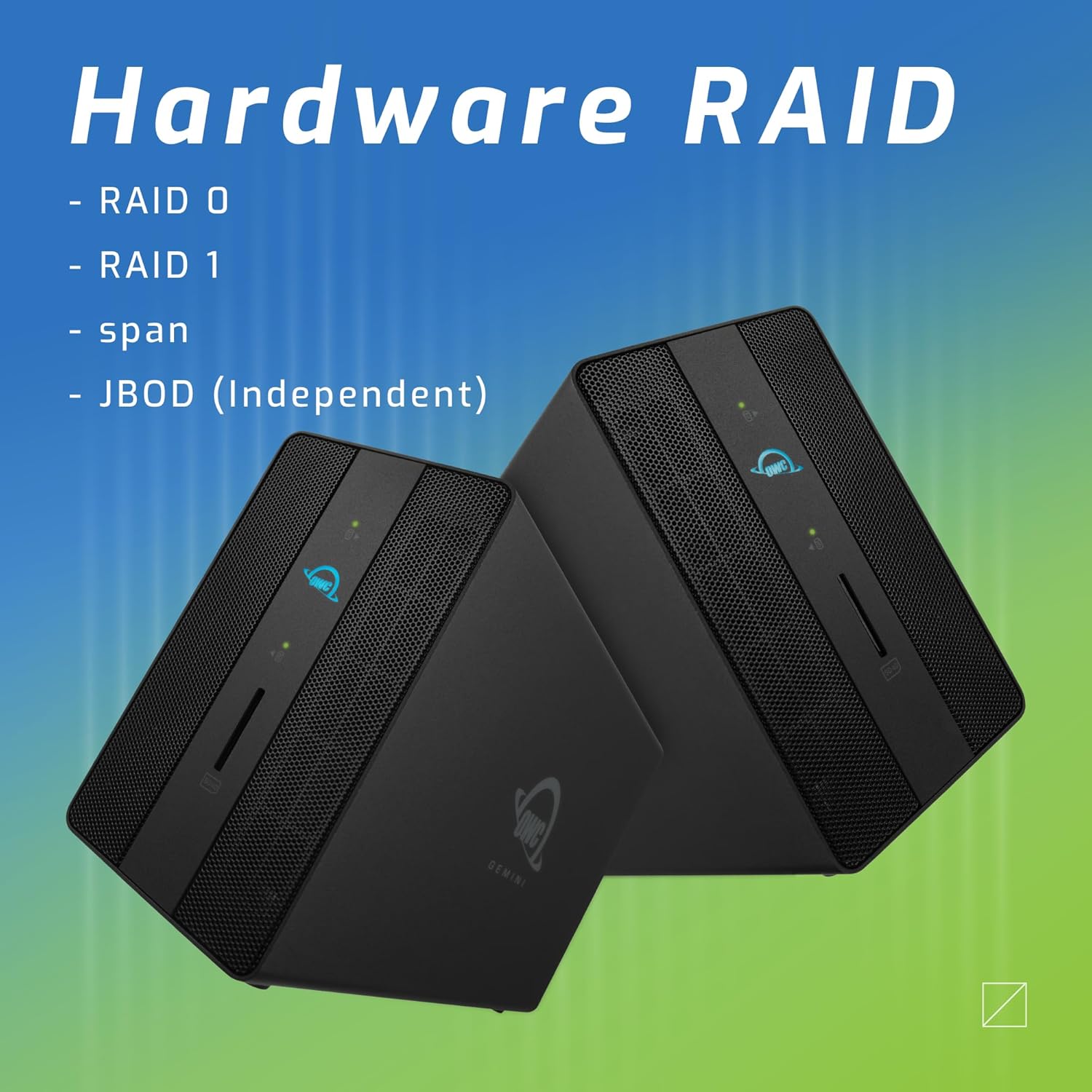
Image: Two OWC Gemini units, emphasizing the hardware RAID capabilities for configurations like RAID 0, RAID 1, SPAN, and JBOD.
RAID Levels Explained:
- RAID 0 (Ho hula): Combines drives for maximum speed and capacity, but offers no data redundancy.
- RAID 1 (Mirroring): Duplicates data across drives for redundancy, sacrificing half the total capacity for data protection.
- SPAN (Concatenation): Combines drives into a single large volume without striping or mirroring.
- JBOD (Just a Bunch Of Disks): Treats each drive as an independent volume.
3. Ho hokela Khomphutheng ea Hao
- Connect the power adapter to the DC 12V power input on the OWC Gemini and then to a power outlet.
- Connect one end of the Thunderbolt (USB-C) cable to the host port on the OWC Gemini.
- Connect the other end of the Thunderbolt (USB-C) cable to a Thunderbolt (USB-C) port on your computer.
- The device should power on automatically.
4. Initializing Drives
After connecting, your operating system may prompt you to initialize and format the new drives. Follow the on-screen instructions. For macOS, use Disk Utility. For Windows, use Disk Management.
Litaelo tsa Ts'ebetso
Phetiso ea Lintlha
Once the drives are initialized and formatted, they will appear as accessible volumes on your computer. You can drag and drop files to and from these volumes as you would with any other storage device.
U sebelisa Likou tsa USB
Connect USB peripherals such as external drives, keyboards, or mice to the two USB 3.2 Gen 2 Type-A ports. These ports support data transfer speeds up to 10 Gb/s.
Ho hokela Pontšo ea Kantle
Use the HDMI 2.1 port to connect an external monitor. The Gemini supports resolutions up to 8K @ 120Hz via HDMI.
Khokahano ea Marang-rang
Connect an Ethernet cable from your network router or switch to the 2.5 Gigabit Ethernet port on the Gemini for high-speed wired network access.
Using the SD Card Slot
Insert an SD 4.0/UHS-II compatible SD card into the front-facing slot for quick data transfer from cameras or other devices.
Daisy-Chaining and Power Delivery

Image: A close-up of the OWC Gemini's Thunderbolt ports, illustrating their use for daisy-chaining, connecting additional displays, and charging USB-C devices.
The second Thunderbolt 3 (USB-C) port allows you to:
- Mokete oa daisy additional Thunderbolt devices.
- Connect an additional display (up to 8K @ 60Hz or 4K @ 120Hz).
- Charge USB-C devices with up to 27 watts of power.
Tlhokomelo
- Ho hloekisa: Sebelisa lesela le bonolo, le omeletseng ho hloekisa bokantle ba sesebelisoa. Se ke oa sebelisa lihloekisi tsa metsi kapa li-aerosol.
- Moea oa moea: Etsa bonnete ba hore li-grill tsa ventilation ha li sitisoe ho thibela mocheso o feteletseng.
- Lisebelisoa tsa Firmware: Periodically check the OWC websebaka sa marang-rang bakeng sa lintlafatso tsa firmware ho netefatsa ts'ebetso e ntle le ho lumellana.
- Ho Ntša Moro o Sireletsehileng: Always safely eject the OWC Gemini from your operating system before disconnecting it or powering it off to prevent data corruption.
Ho batle phoso
Sesebelisoa ha se Tsejoe
- Ensure all cables are securely connected, especially the Thunderbolt cable to both the Gemini and your computer.
- Verify the power adapter is correctly connected and the device is receiving power.
- Try connecting the Gemini to a different Thunderbolt port on your computer.
- Qala komporo ea hau bocha.
- Check your operating system's Disk Utility (macOS) or Disk Management (Windows) to see if the drives are detected but uninitialized or unformatted.
Slow Data Transfer Speeds
- Ensure you are using a Thunderbolt 3 compatible cable and port.
- Check the RAID configuration. RAID 1 (mirroring) will have slower write speeds than RAID 0 (striping).
- Close any unnecessary applications that might be consuming system resources.
- Ensure your computer's drivers are up to date.
Bontša Mathata
- Verify the HDMI cable is securely connected to both the Gemini and your monitor.
- Check your display settings in your operating system.
- Ensure your monitor supports the resolution and refresh rate you are attempting to use.
- Try a different HDMI cable or monitor if available.
Mathata a Khokahano ea Marang-rang
- Ensure the Ethernet cable is securely connected to both the Gemini and your network device.
- Hlahloba di-setting tsa netweke ya khomphutha ya hao.
- Qala router/modem ea hau bocha.
Litlhaloso
| Sebopeho | Lintlha |
|---|---|
| Brand | OWC |
| Nomoro ea Mohlala | OWCTB3GM000H32 |
| Bokhoni ba polokelo | 32.0TB (as configured) |
| Drive Bays | 2 (supports 2.5" and 3.5" SATA drives) |
| Maemo a RAID | SPAN, RAID 0, RAID 1, JBOD (Hardware RAID) |
| Sebaka sa Phallo | Thunderbolt 3 (USB-C) |
| Sekhahla sa Phetiso ea Lintlha | Up to 40 Gb/s (Thunderbolt 3), Up to 10 Gb/s (USB 3.2 Gen 2) |
| Boema-kepe | (1) Thunderbolt 3 (USB-C) Host, (1) Thunderbolt 3 (USB-C) Downstream, (2) USB 3.2 Gen 2 Type-A, (1) HDMI 2.1, (1) 2.5 Gigabit Ethernet, (1) SD 4.0/UHS-II |
| Bontša Tšehetso | HDMI 2.1: Up to 8K @ 120Hz; Thunderbolt 3: Up to 8K @ 60Hz or 4K @ 120Hz |
| Phano ea Matla | Up to 27W via Thunderbolt 3 |
| Lisebelisoa tse lumellanang | Desktop, Laptop, Tablet (with Thunderbolt/USB-C port) |
| Mmala | Ntsho |
| Boima ba 'mele | 9.35 lbs (hoo e ka bang.) |
| UPC | 810100983697 |
Warranty le Tšehetso
Boitsebiso ba Warranty
OWC products are covered by a limited warranty. Please refer to the official OWC websebaka sa marang-rang kapa tokomane ea hau ea theko bakeng sa lipehelo le maemo a itseng a tiisetso. Boloka bopaki ba hau ba theko bakeng sa likopo tsa tiisetso.
Tšehetso ea tekheniki
For technical assistance, troubleshooting, or further inquiries, please visit the official OWC support websebaka kapa ikopanye le litšebeletso tsa bareki.


