1. Selelekela
This manual provides comprehensive instructions for the installation, operation, and maintenance of your Yale YSV/200/DB1 Value Electronic Safe. Please read this manual thoroughly before using the safe to ensure proper function and security.

Setšoantšo: Pele view of the Yale YSV/200/DB1 Value Electronic Safe.
2. Boitsebiso ba Tšireletseho
- Do not store the emergency override keys inside the safe. Keep them in a secure, separate location.
- Netefatsa hore tšireletso e kentsoe ka mokhoa o sireletsehileng ho thibela ho tlosoa ntle ho tumello.
- Replace batteries promptly when the low battery indicator appears to avoid being locked out.
- Keep the safe away from excessive moisture or extreme temperatures.
3. Likahare tsa Sephutheloana
Netefatsa hore lintho tsohle li teng ka har'a sephutheloana:
- Yale YSV/200/DB1 Electronic Safe Unit
- Emergency Override Keys (2)
- 4 x AAA Batteries
- Mounting Hardware (bolts/screws)
- Bukana ea mosebelisi (tokomane ena)
4. Seta
4.1 Ho kenya Betri
The safe requires 4 AAA batteries for operation. These are included in your package.
- Open the safe door using the emergency override key (see section 5.3 if needed).
- Locate the battery compartment on the inside of the safe door.
- Kenya libeteri tsa 4 AAA, ho netefatsa polarity e nepahetseng (+/-).
- Koala sekoaelo sa karolo ea betri.

Image: Detail of the electronic keypad and manual override lock.
4.2 Ho Hloma Poloko
For enhanced security, it is recommended to securely mount the safe to a floor or wall using the provided hardware.
- Choose a suitable location for mounting. Ensure the surface is solid and can support the weight of the safe and its contents.
- Mark the drilling points through the pre-drilled holes inside the safe.
- Drill pilot holes into the chosen surface.
- Position the safe and secure it using the provided mounting bolts/screws.
- Ensure the safe is firmly attached and does not wobble.
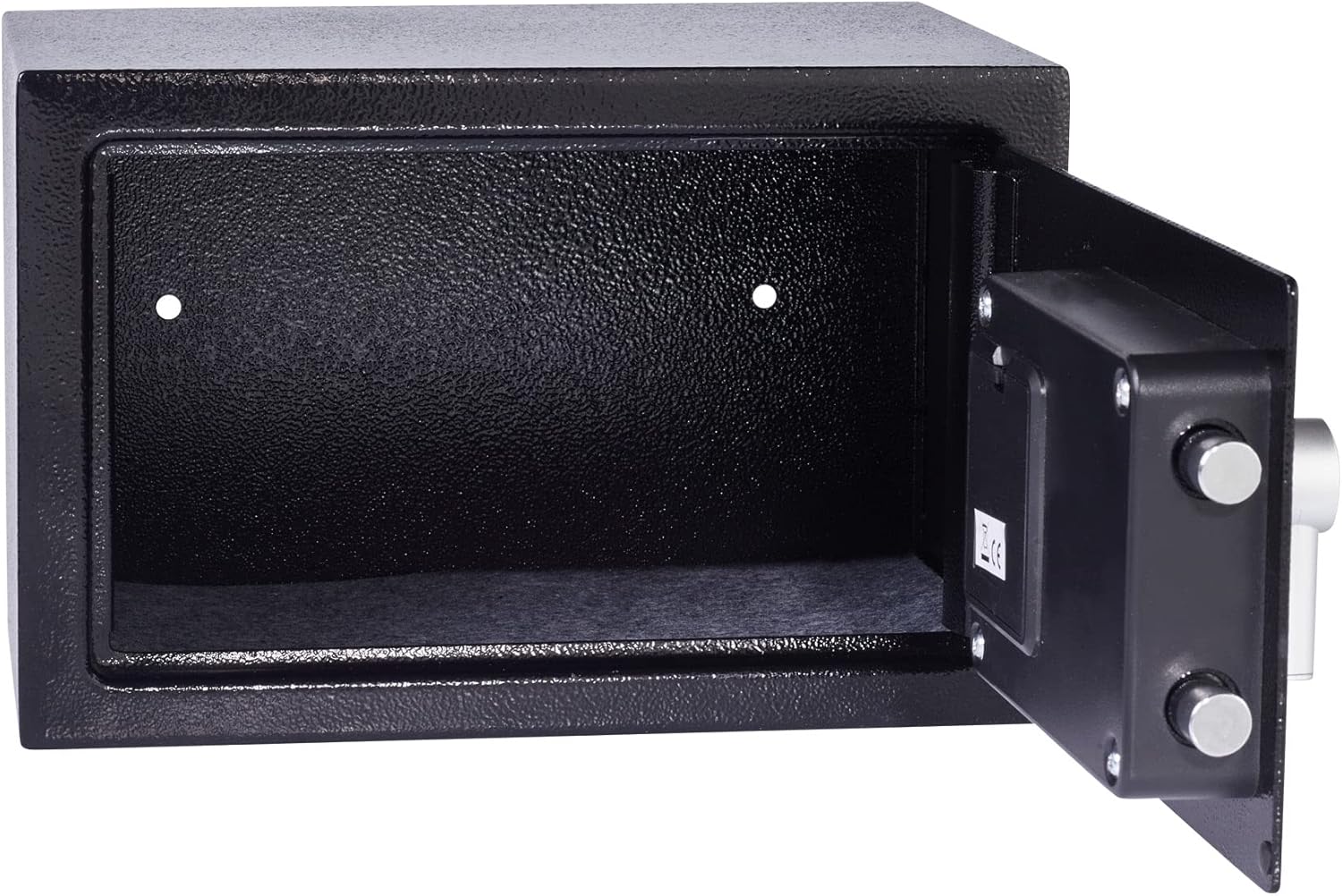
Image: Interior of the safe showing pre-drilled mounting holes.
5. Litaelo tsa Ts'ebetso
5.1 Setting Your User Code
The safe comes with a factory default code (usually 1-2-3-4 or similar, refer to quick start guide if provided). It is crucial to change this immediately.
- With the safe door open, press the red or green reset button located on the inside of the door (often near the hinge or battery compartment). The safe will beep, and the yellow indicator light will illuminate.
- Enter your new personal code (3-8 digits) on the keypad.
- Press the 'E' or '#' button to confirm. The safe will beep again, and the yellow light will turn off, indicating the new code is set.
- Test the new code multiple times with the door open before closing it.

Image: Safe door open, revealing the interior and locking mechanism.
5.2 Opening the Safe with Your Code
- Enter your personal code on the keypad.
- Press the 'E' or '#' button. The green indicator light will illuminate.
- Within 5 seconds, turn the knob clockwise to open the safe door.
5.3 Using the Emergency Override Key
In case of forgotten code or battery failure, the safe can be opened using the emergency override key.
- Locate the keyhole, usually hidden behind a small cover on the keypad panel.
- Insert the emergency override key and turn it counter-clockwise.
- While holding the key turned, rotate the knob clockwise to open the safe door.
- Once open, remove the key.
Video: Demonstrates opening the Yale safe using the electronic keypad and the emergency override key. It shows the keypad entry, turning the knob, and the use of the hidden keyhole.
6. Tlhokomelo
6.1 Phetoho ea Betri
When the batteries are low, the red indicator light will flash or remain on after entering your code. Replace all 4 AAA batteries promptly to ensure continued operation.
- Bula monyako o sireletsehileng.
- Locate the battery compartment on the inside of the door.
- Tlosa libeteri tsa khale 'me u li lahle ka boikarabelo.
- Insert new 4 AAA batteries, observing correct polarity.
- Koala sekoaelo sa karolo ea betri.
6.2 Ho hloekisa
Hloekisa bokantle ba sesefo ka mochini o bonolo, damp cloth. Do not use abrasive cleaners or solvents, as these can damage the finish or electronic components.
7. Ho rarolla mathata
| Bothata | Lebaka le ka khonehang | Tharollo |
|---|---|---|
| Safe does not open with code. | Incorrect code entered, low batteries, or keypad malfunction. |
|
| Keypad ha e arabe. | Libetri tse shoeleng. | Replace batteries immediately. Use emergency override key to open if necessary. |
| Monyako ha o koalehe hantle. | Obstruction, or locking bolts are extended. | Ensure nothing is blocking the door. Turn the knob to retract bolts before closing. |
8. Litlhaloso
- Mohlala: YSV/200/DB1
- Litekanyo tsa Kantle (H x W x D): 200 x 310 x 200 mm (hoo e ka bang 7.87 x 12.2 x 7.87 inches)
- Litekanyo tsa ka Hare (H x W x D): 197 x 307 x 150 mm (hoo e ka bang 7.75 x 12.08 x 5.9 inches)
- Boima ba 'mele: 4.49kg (hoo e ka bang 9.9 lbs)
- Bokhoni: 8 Lithara
- Mokhoa oa ho notlela: Electronic keypad with 22mm motorized locking bolts, 6-lever double-bitted manual override lock.
- Boitsebiso: Alloy Steel
- Matla: 4 x AAA Batteries (e kenyelelitsoe)
- Likarolo tse Khethehileng: Laser cut door, reinforced hinge, armored steel anti-drill plates.
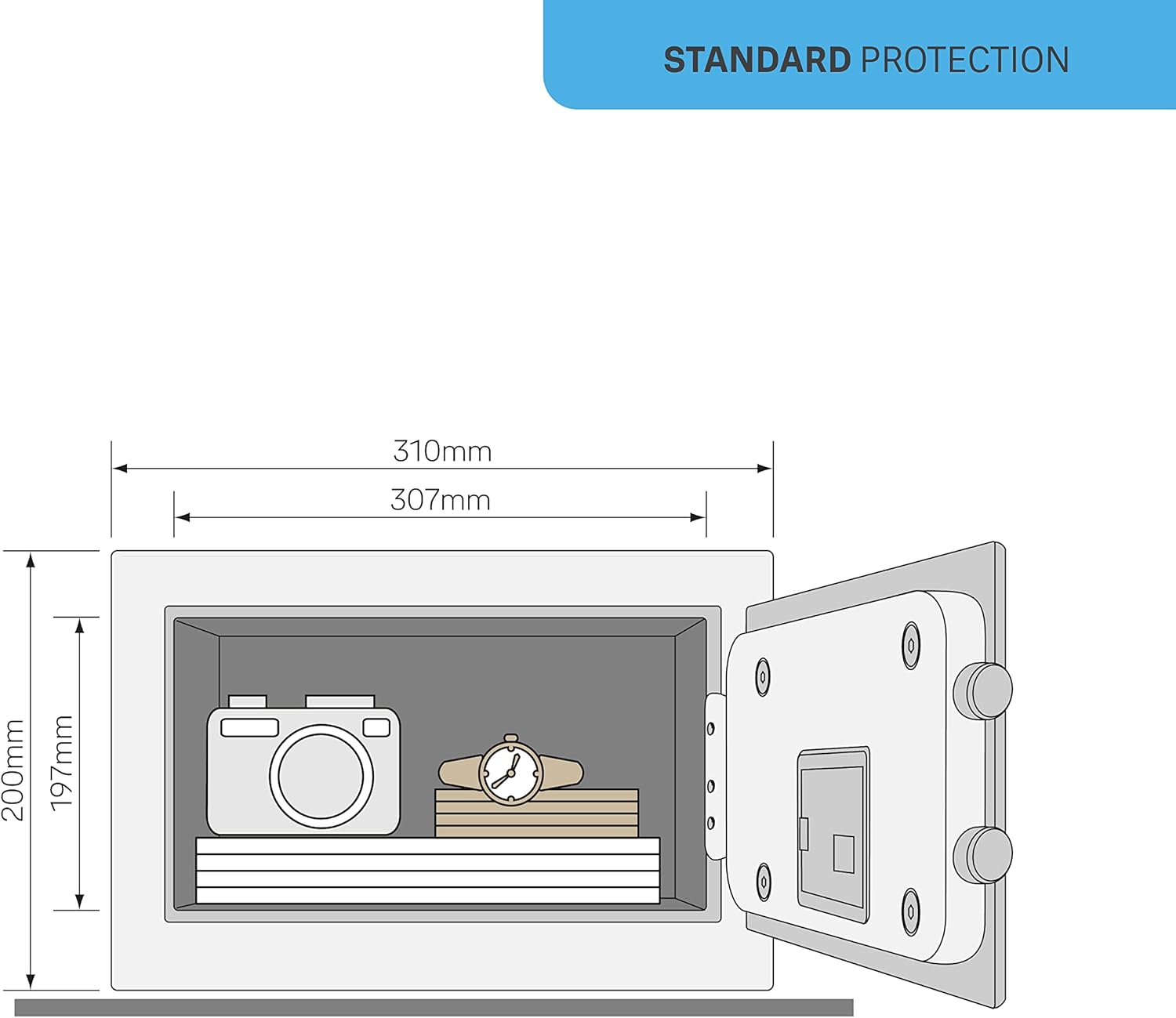
Image: Dimensional diagram of the safe, illustrating height, width, and depth.
9. Tiisetso le Tšehetso
For warranty information or technical support, please refer to the official Yale website or contact your local Yale distributor. Keep your purchase receipt as proof of purchase.


