1. Selelekela
This manual provides instructions for the safe and effective use of the Sealey MM19 Digital Multimeter. The MM19 is a general-purpose multimeter designed for measuring various electrical parameters, including AC and DC voltage, DC current, resistance, audible continuity, and diode/transistor verification. Please read this manual thoroughly before operation and retain it for future reference.
2. Boitsebiso ba Tšireletseho
Always observe basic safety precautions when using electrical test equipment to reduce the risk of fire, electric shock, or personal injury. This device complies with IEC 1010 and CE CAT II safety standards.
- Do not exceed the maximum input limits for any function. Refer to the specifications section for details.
- Le ka mohla u se ke ua sebelisa voltage to the meter when the rotary switch is set to Resistance (Ω), Diode, Continuity, or Current (A) functions.
- E-ba hlokolosi ha u sebetsa le voltage kaholimo ho 30V AC RMS, tlhoro ea 42V, kapa 60V DC. Tsena voltage baka kotsi e tshosang.
- Ensure the test leads are in good condition, without cracked or broken insulation.
- Always connect the common (COM) test lead first and disconnect it last.
- Disconnect power to the circuit under test before measuring resistance or continuity.
- Tlosa betri hang-hang when the low battery indicator appears to ensure accurate readings.
3. Sehlahisoa Overview
The Sealey MM19 Digital Multimeter features a clear LCD display, a central rotary switch for function selection, and input jacks for test leads.
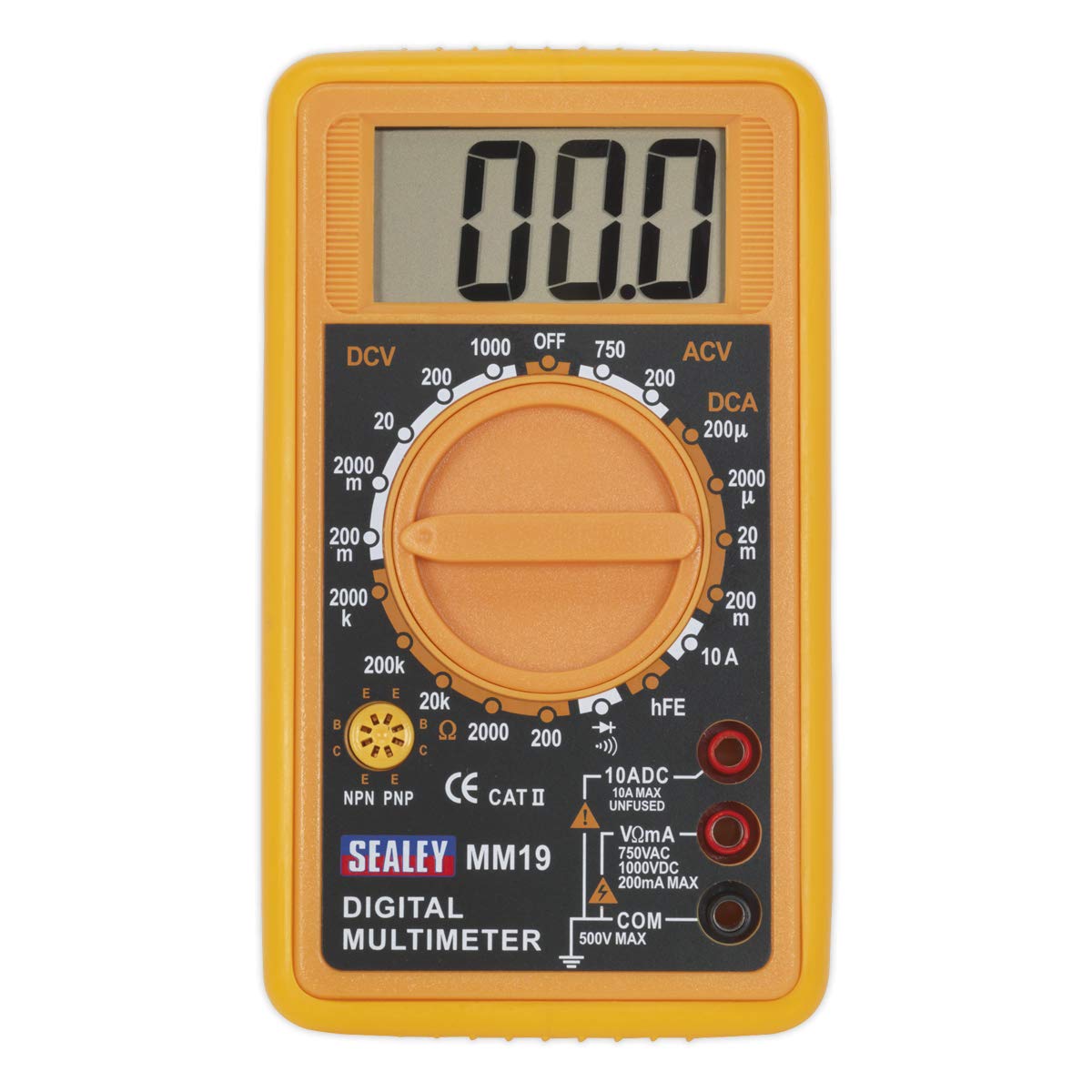
The Sealey MM19 Digital Multimeter, shown with its yellow casing, large LCD display, rotary function switch, and red and black test leads connected to the input jacks.
Likaroloana:
- Pontšo ea LCD: Large (46 x 25mm) digital display for reading measurements.
- Phetoho ea Rotary: Used to select the desired measurement function and range.
- VΩmA Input Jack: Bakeng sa voltage, resistance, and current measurements up to 200mA.
- 10ADC Input Jack: For high current measurements up to 10A DC (unfused).
- COM Input Jack: Kenyelletso e tloaelehileng (e mpe) bakeng sa litekanyo tsohle.
- Sokete ea hFE: For transistor (NPN/PNP) testing.
- Baetapele ba Tlhahlobo: Red (positive) and Black (negative) leads for connecting to circuits.
4. Seta
4.1. Ho kenya Battery
The Sealey MM19 Multimeter requires a 9V battery for operation. If the display does not illuminate or shows a low battery indicator, the battery needs to be installed or replaced.
- Netefatsa hore multimeter e TIMILOE.
- Beha sekoaelo sa karolo ea betri ka morao ho yuniti.
- Remove the screw(s) securing the cover and carefully lift it off.
- Connect a new 9V battery to the battery clips, observing correct polarity.
- Place the battery inside the compartment and replace the cover, securing it with the screw(s).
4.2. Baetapele ba Liteko ba Hokelang
The multimeter is supplied with a pair of test leads (red and black).
- Kenya the teko e ntšo ho kena ho COM Jacke ea ho kenya (e Tloaelehileng).
- Bakeng sa boholo ba litekanyo (voltage, resistance, low current), insert the teko e khubelu ho kena ho VΩmA jeke ea ho kenya.
- For high DC current measurements (up to 10A), insert the teko e khubelu ho kena ho 10ADC jeke ea ho kenya.
5. Litaelo tsa Ts'ebetso
To operate the multimeter, select the desired function and range using the rotary switch.
5.1. Tekanyo ea DC Voltage (DCV)
- Insert the red lead into the VΩmA jack and the black lead into the COM jack.
- Set the rotary switch to the desired DCV range (e.g., 200m, 2000m, 20, 200, 1000). Start with the highest range if the voltage ha e tsejoe.
- Hokela lithapo tsa teko ho pholletsa le karolo kapa potoloho e lokelang ho lekanyetsoa.
- Bala voltage bohlokoa ponts'ong ea LCD.
5.2. Ho lekanya AC Moqtage (ACV)
- Insert the red lead into the VΩmA jack and the black lead into the COM jack.
- Set the rotary switch to the desired ACV range (e.g., 200, 750). Start with the highest range if the voltage ha e tsejoe.
- Hokela lithapo tsa teko ho pholletsa le karolo kapa potoloho e lokelang ho lekanyetsoa.
- Bala voltage bohlokoa ponts'ong ea LCD.
5.3. Ho lekanya DC Current (DCA)
- For currents up to 200mA: Insert the red lead into the VΩmA jack and the black lead into the COM jack.
- For currents up to 10A: Insert the red lead into the 10ADC jack and the black lead into the COM jack.
- Set the rotary switch to the desired DCA range (e.g., 200μ, 2000μ, 20m, 200m, 10A). Start with the highest range if the current is unknown.
- Tlosa motlakase ho potoloho. Open the circuit where the current is to be measured.
- Connect the multimeter in series with the circuit.
- Apply power to the circuit and read the current value on the LCD display.
5.4. Khanyetso ea ho Lekanya (Ω)
- Insert the red lead into the VΩmA jack and the black lead into the COM jack.
- Set the rotary switch to the desired Resistance (Ω) range (e.g., 200, 2000, 20k, 200k, 2000k).
- Netefatsa hore potoloho e tlas'a teko e felisitsoe matla.
- Hokela lintlha tsa tlhahlobo ho pholletsa le karolo ho lekanngoa.
- Bala boleng ba khanyetso ponts'ong ea LCD.
5.5. Teko ea Tsoelo-pele e Utloahalang
- Insert the red lead into the VΩmA jack and the black lead into the COM jack.
- Set the rotary switch to the continuity symbol (speaker icon).
- Netefatsa hore potoloho e tlas'a teko e felisitsoe matla.
- Connect the test leads across the component or wire.
- If continuity exists (low resistance), the meter will emit an audible tone. The display will show the resistance value.
5.6. Diode/Transistor Verification Mode (hFE)
- Insert the red lead into the VΩmA jack and the black lead into the COM jack for diode testing.
- Set the rotary switch to the diode symbol.
- Connect the red lead to the anode and the black lead to the cathode of the diode. The display will show the forward voltage theoha. Khutlisetsa morao; ponts'o e lokela ho bonts'a 'OL' (loop e bulehileng) bakeng sa diode e ntle.
- For transistor hFE measurement, insert the transistor leads (Emitter, Base, Collector) into the appropriate sockets (E, B, C) in the hFE test socket, ensuring correct NPN or PNP type selection.
- Read the hFE value on the LCD display.
6. Tlhokomelo
6.1. Ho hloekisa
Hlakola mithara casing ka papatsoamp lesela le sesepa se bonolo. U se ke ua sebelisa li-abrasives kapa solvents. Netefatsa hore mitha e omme ka botlalo pele o sebelisoa.
6.2. Phetoho ea Battery
Refer to Section 4.1 for battery installation instructions. Replace the 9V battery when the low battery indicator appears on the display to maintain measurement accuracy.
7. Ho rarolla mathata
- Ha ho Pontšo: Check battery installation and ensure the battery has sufficient charge.
- 'OL' or '1' on Display: This usually indicates an over-range condition or an open circuit. Select a higher range or check connections.
- Litemana tse Fosahetseng: Ensure the correct function and range are selected. Check test lead connections and battery condition.
- No Continuity Tone: Verify the circuit is de-energized and the leads are making good contact.
8. Litlhaloso
| Paramethara | Boleng |
|---|---|
| Brand | Sealey |
| Nomoro ea Mohlala | MM19 |
| Mohloli oa Matla | E Tsamaisa Betri (9V) |
| Pontšo | Digital LCD (46 x 25mm) |
| DC Moqtage (DCV) | 200mV, 2000mV, 20V, 200V, 1000V |
| Mofuta oa AC Voltage (ACV) | 200V, 750V |
| DC Hajoale (DCA) | 200µA, 2000µA, 20mA, 200mA, 10A |
| Khanyetso (Ω) | 200Ω, 2000Ω, 20kΩ, 200kΩ, 2000kΩ |
| Tsoelo-pele | Audible tone below approx. 30Ω |
| Teko ea Diode | Tsoela pele voltage drop display |
| Teko ea Transistor | hFE (NPN/PNP) |
| Lintlha tsa polokeho | CE CAT II, IEC 1010 |
| Litekanyo (L x W x H) | 1.93 x 4.21 x 6.06 lisenthimithara |
| Boima ba Ntho | Li-ounces tse 9.5 (0.27 lik'hilograma) |
9. Tiisetso le Tšehetso
For warranty information or technical support, please refer to the documentation provided with your purchase or contact Sealey customer service directly. Keep your proof of purchase for any warranty claims.


