1. Selelekela
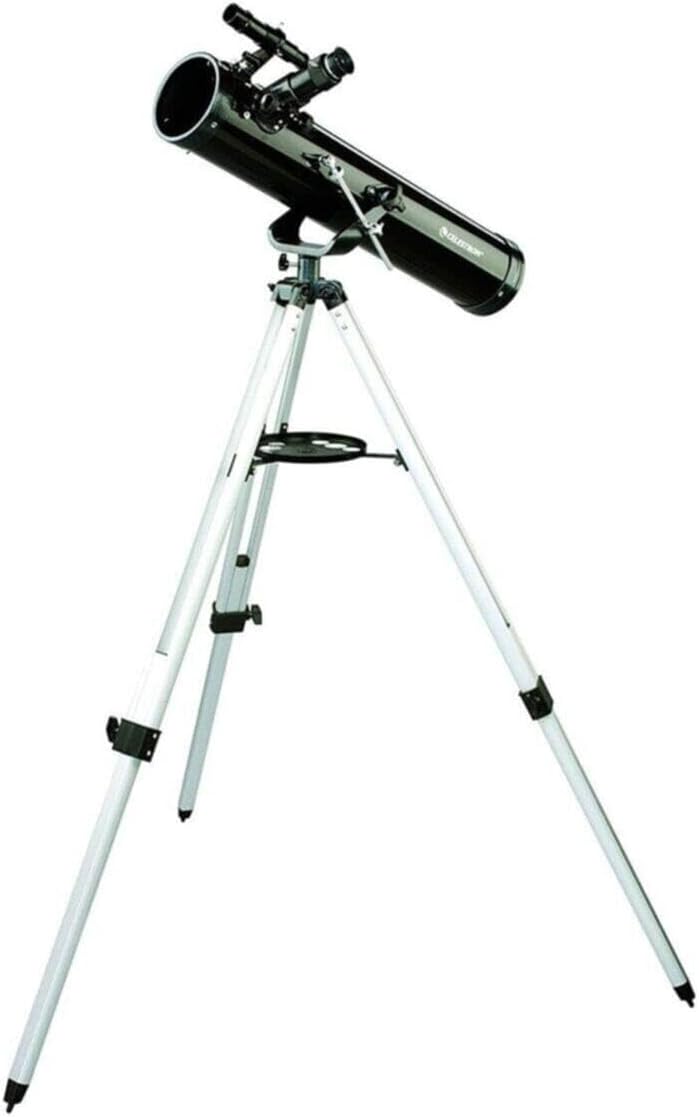
The Celestron PowerSeeker 76AZ telescope is designed for aspiring astronomers, offering a combination of quality and features for observing celestial objects. This Newtonian reflector telescope features a 76mm aperture and a 700mm focal length, providing enhanced image brightness and clarity through its fully coated glass optical components. Its altazimuth mount is suitable for both astronomical and terrestrial viewng.
2. Se ka Lebokoseng
Hlakola likarolo tsohle ka hloko 'me u netefatse hore u fumane lintho tse latelang:
- PowerSeeker 76 Telescope Optical Tube
- Thaba ea Altazimuth
- Aluminum Tripod with Accessory Tray
- 5x24 Finderscope
- 20mm Eyepiece (1.25")
- 4mm Eyepiece (1.25")
- 3x Barlow Lens (1.25")
3. Seta
Assembly of your PowerSeeker 76AZ telescope is straightforward and requires no tools. Follow these steps to prepare your telescope for observation:
- Kopanya Tripod: Extend the legs of the aluminum tripod to a stable position. Attach the accessory tray to the tripod's center brace.
- Hokela Thaba: Secure the altazimuth mount to the top of the tripod. Ensure it is firmly tightened.
- Mount the Optical Tube: Place the telescope optical tube onto the altazimuth mount. Secure it using the provided mounting screws or clamps.
- Install the Finderscope: Slide the 5x24 finderscope into its bracket on the optical tube and tighten the retaining screws.
- Insert an Eyepiece: Insert either the 20mm or 4mm eyepiece directly into the focuser. For higher magnification, you can first insert the 3x Barlow lens into the focuser, then insert an eyepiece into the Barlow lens.
4. Operating the Telescope
Once assembled, your telescope is ready for observation. Familiarize yourself with its controls for optimal viewng.
4.1. Aligning the Finderscope
The finderscope helps locate objects before viewing them through the main telescope. To align it:
- Point the main telescope at a distant, easily identifiable terrestrial object (e.g., a treetop or street sign) during daylight hours.
- Center the object in the main telescope's 20mm eyepiece.
- Look through the finderscope and adjust its alignment screws until the crosshairs are centered on the same object.
4.2. Ho tsepamisa maikutlo
To achieve a clear image, rotate the focuser knob until the object appears sharp. Always start with the lowest power eyepiece (20mm) for a wider field of view, then switch to higher power (4mm) or use the Barlow lens for more detailed observation.
4.3. Using Eyepieces and Barlow Lens
- 20mm Eyepiece: Provides lower magnification and a wider field of view, ideal for locating objects and observing larger celestial bodies like the Moon or star clusters.
- 4mm Eyepiece: Offers higher magnification for detailed views of planets or lunar features. Use after locating the object with the 20mm eyepiece.
- 3x Barlow Lens: Increases the magnification of any eyepiece by three times. Insert the Barlow into the focuser first, then insert an eyepiece into the Barlow.

4.4. Altazimuth Mount Operation
The altazimuth mount allows for simple up-and-down (altitude) and left-and-right (azimuth) movement. Loosen the tension knobs slightly to move the telescope manually, then tighten them to hold its position. The slow-motion control rod provides fine adjustments for tracking objects.

4.5. Observing the Moon
The Moon is an excellent first target. Its bright surface and numerous craters offer spectacular views even with modest magnification. Start with the 20mm eyepiece to see the entire lunar disk, then switch to the 4mm eyepiece or use the Barlow lens to explore specific craters and mountain ranges.

5. Tlhokomelo
Proper care and maintenance will ensure the longevity and performance of your telescope.
5.1. Cleaning Optics
Dust and moisture can accumulate on the telescope's lenses and mirrors. Handle optical surfaces with extreme care.
- Lerōle: Use a camel's hair brush or a can of compressed air (never blow with your mouth) to gently remove loose dust.
- Fingerprints/Smudges: For stubborn marks, use a specialized optical cleaning solution and lens tissue. Apply a small amount of solution to the tissue, not directly to the lens, and wipe gently in a circular motion from the center outwards.
- Never touch optical surfaces with your fingers.

5.2. Polokelo
When not in use, store your telescope in a dry, dust-free environment. Keep all caps on the optical tube and eyepieces to prevent dust accumulation.
6. Ho rarolla mathata
If you encounter issues with your telescope, consult the following common problems and solutions:
- Setšoantšo se lerootho kapa ha se shebahale hantle:
- Adjust the focuser knob slowly until the image is sharp.
- Ensure the eyepiece is fully inserted into the focuser or Barlow lens.
- Atmospheric conditions (heat waves, turbulence) can cause blurring, especially at high magnifications. - Cannot find objects:
- Verify that the finderscope is properly aligned with the main telescope (refer to Section 4.1).
- Start with the 20mm eyepiece for a wider field of view to locate objects, then switch to higher magnification.
- Ensure you are observing from a dark location away from light pollution. - Image is dim or faint:
- This telescope has a 76mm aperture, which is suitable for brighter objects like the Moon and planets. Faint deep-sky objects may appear dim.
- Observe from a dark-sky site to maximize light gathering.
- Avoid using excessively high magnification, as it can dim the image. - View is wobbly or unstable:
- Ensure the tripod legs are fully extended and locked, and placed on a stable, level surface.
- Keep the tripod legs as short as possible while still allowing comfortable viewng.
- Tighten all knobs and screws on the mount and optical tube.
7. Litlhaloso
| Moqapi oa Optical | Newtonian Reflector |
| Sekoti | 76 mm (lisenthimithara tse 3) |
| Bolelele ba Tsepamiso | 700 limilimithara |
| Karo-karolelano | f/9.2 |
| Mofuta oa Thaba | Altazimuth |
| Sebaka sa marang-rang | 5x24 |
| Lisebelisoa tsa mahlo | 20mm, 4mm (1.25") |
| Lense ea Barlow | 3x (1.25") |
| Tripod | Aluminum with Accessory Tray |
| Litekanyo (tse kopantsoeng) | 29 x 10 x 9 lisenthimithara (hoo e ka bang) |
| Boima ba Ntho | 13.97 liponto |
8. Tiisetso le Tšehetso
For technical assistance, warranty information, or customer service inquiries regarding your Celestron PowerSeeker 76AZ Telescope, please contact Celestron customer support directly. Refer to the official Celestron websebaka sa marang-rang kapa sephutheloana sa sehlahisoa bakeng sa lintlha tsa morao-rao tsa puisano le lipehelo tsa waranti.


