
1. Selelekela
This manual provides essential instructions for the installation, operation, and maintenance of your Aninerel 3000W Hybrid Solar Inverter, model ANJ-3KW-LV-WIFI. This device is designed to convert 24V DC power to 110V AC pure sine wave power, suitable for various off-grid and backup power applications. Please read this manual thoroughly before installation and use to ensure safe and efficient operation.
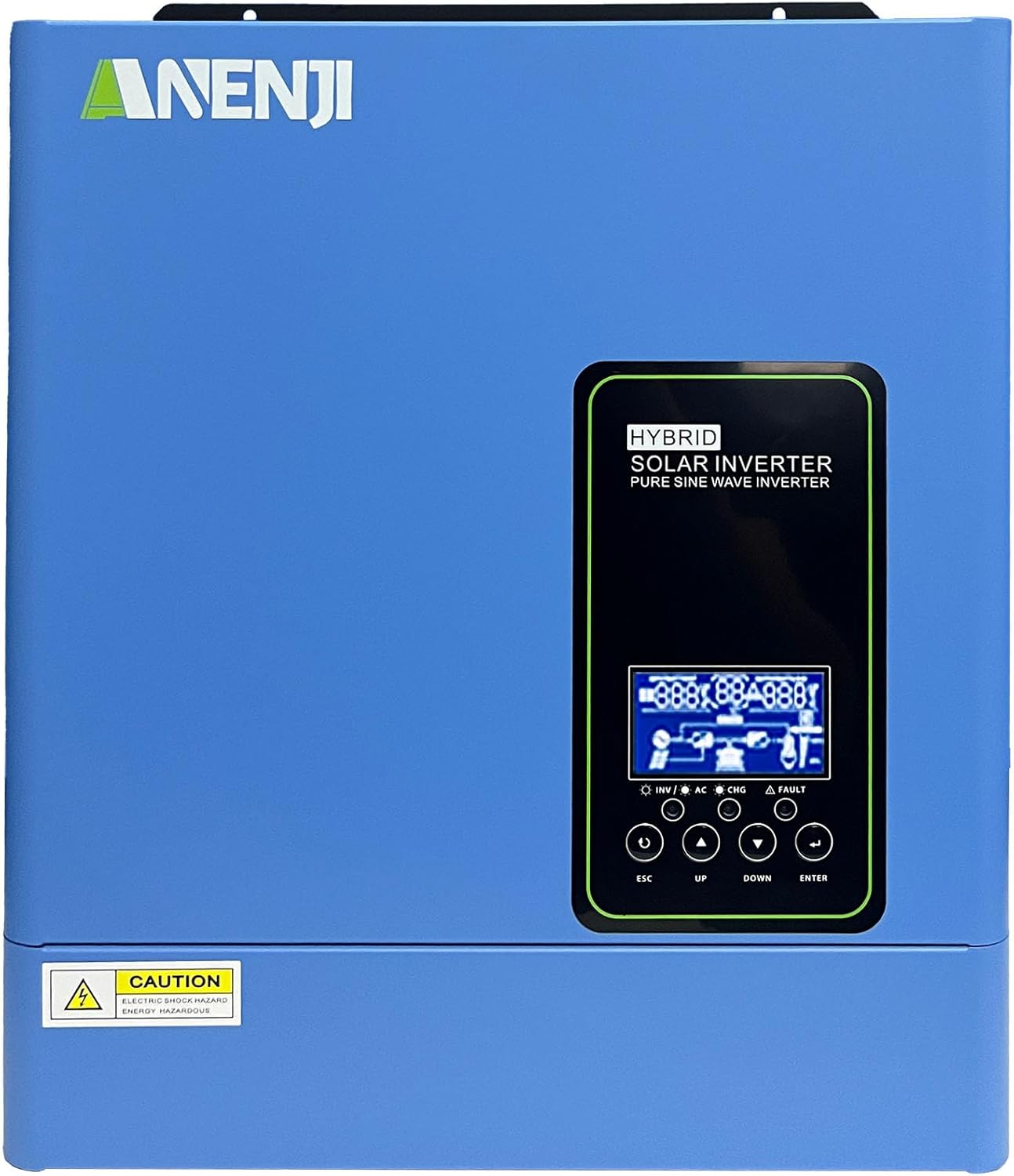
Setšoantšo sa 1.1: Pele view of the Aninerel 3000W Hybrid Solar Inverter. The inverter features a blue casing with the Aninerel logo and a central LCD display panel with control buttons.
2. Litaelo tsa Tšireletso
Kamehla ela hloko mehato e latelang ea tšireletso ho fokotsa kotsi ea ho tsosoa ke motlakase, mollo kapa kotsi:
- Read all instructions and cautionary markings on the unit and in this manual before installation or operation.
- Do not disassemble the inverter. Refer servicing to qualified personnel. Incorrect reassembly may result in electric shock or fire.
- Ho fokotsa kotsi ea ho tsukutloa ke motlakase, khaola likhoele tsohle pele u leka ho lokisa kapa ho hloekisa.
- This inverter is designed for indoor or semi-outdoor use with an IP65 rating. Avoid direct exposure to rain or snow.
- Ensure proper ventilation around the inverter to prevent overheating. Do not block ventilation openings.
- Use appropriate tools and personal protective equipment during installation.
- Ensure all wiring connections are tight and secure to prevent loose connections that can cause overheating.
- Do not connect the inverter to a public utility grid without proper authorization and safety measures.
3. Sehlahisoa Overview
The Aninerel 3000W Hybrid Solar Inverter integrates a pure sine wave inverter, an MPPT solar charge controller, and a battery charger into one compact unit. It is designed to provide uninterrupted power support.
3.1 Likarolo tsa Bohlokoa
- 3000W Pure Sine Wave Output: Converts 24V DC to 110V AC, providing stable power for sensitive electronics.
- Integrated 100A MPPT Solar Charge Controller: Maximizes solar energy harvesting with up to 500VDC PV input.
- Flexible Charging and Output Modes: Offers multiple modes (Solar Only, AC Priority, Hybrid Charging; Mains Priority, PV Priority, Hybrid Output) for diverse power management.
- Wide Battery Compatibility: Supports AGM, GEL, Lead-acid, Li-ion, and LiFePO4 24V batteries.
- Smart LCD Pontšo: Provides real-time monitoring and allows for easy configuration of system settings.
- Wi-Fi e hahiloeng ka hare: Enables remote monitoring of the inverter status (registration required).
- Moralo o tiileng: IP65-rated enclosure for durability in various environments, with intelligent cooling.
- Tšireletso e Felletseng: E kenyelletsa overvolvetage, ho se tsotelletage, reverse polarity, and short circuit protection.

Setšoantšo sa 3.1: Phanele e ka Pele le e ka Morao e Holimoview. This diagram labels the LCD display, indicators, function buttons, RS485 communication port, grounding terminal, battery input, dry contact port, built-in Wi-Fi, AC input, AC output, PV input, and power on/off switch.
3.2 Front Panel and Indicators
- Pontšo ea LCD: Shows system status, operational data, and configuration settings.
- Lesupa la ho tjhaja: Illuminates to indicate battery charging status.
- Lesupa la Boemo: Provides general operational status of the inverter.
- Sesupo sa Phoso: Lights up to signal system errors or warnings.
- Function Buttons (ESC, UP, DOWN, ENTER): E sebelisoa bakeng sa ho tsamaisa menyetla le ho lokisa litlhophiso ho LCD.
3.3 Lihokelo tsa Panel tse ka Morao
- Boema-kepe ba Khokahano ea RS485: Bakeng sa puisano le tlhokomelo ea kantle.
- Seteishene sa motheo: Essential for safety grounding.
- Kenyo ea Betri: Connects to the 24V battery bank.
- Dry Contact Port: Bakeng sa taolo ya kantle kapa pontsho.
- Built-in Wi-Fi Module: For wireless monitoring.
- Kenyo ea AC: Connects to grid utility or generator AC power.
- Tlhahiso ea AC: E hokahanya le meroalo ea lapeng.
- Kenyo ea PV: E hokahana le likarolo tsa solar panel.
- Phetoho ea ho tima/ea ho tima: Controls the main power to the inverter.
4. Tlhophiso & Seta
Proper installation is crucial for the safe and efficient operation of your hybrid solar inverter. Ensure all connections are made by a qualified electrician and adhere to local electrical codes.
4.1 Ho kenya Inverter
- Choose a suitable location that is dry, well-ventilated, and protected from direct sunlight and moisture.
- Ensure sufficient clearance around the inverter for proper airflow and cooling.
- Mount the inverter vertically on a sturdy surface using appropriate fasteners.
4.2 Mahokelo a Wiring
Follow the wiring diagram carefully. All wiring should be performed with the inverter and all power sources disconnected.
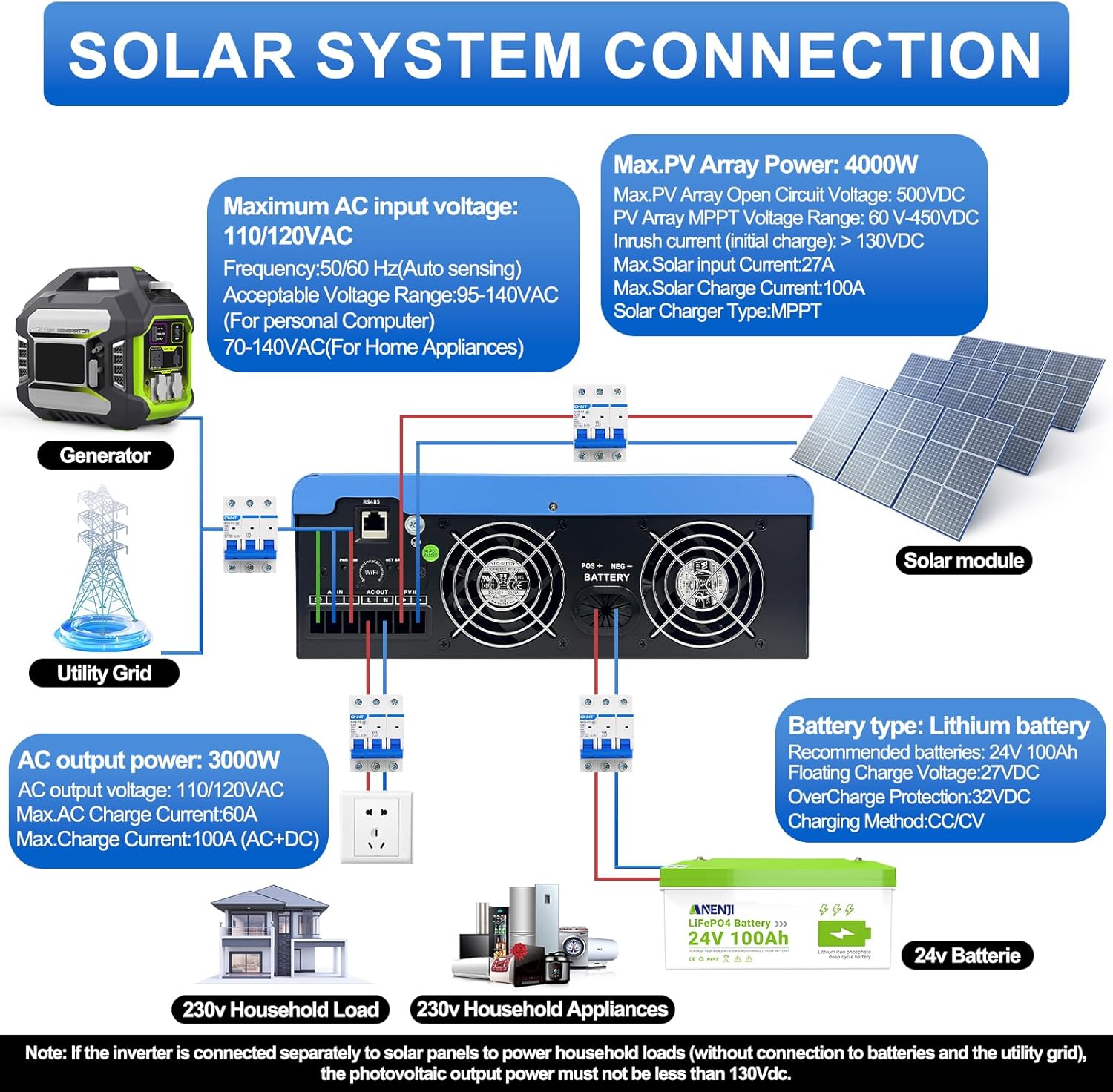
Figure 4.1: Solar System Connection Diagram. This diagram illustrates the connections for solar panels, generator, utility grid, 24V battery, and household loads to the inverter. It shows the PV input, battery input, AC input, and AC output terminals.
4.2.1 Khokelo ea Betri
- Connect the 24V battery bank to the battery input terminals on the inverter. Ensure correct polarity (+ to + and - to -).
- Use appropriate cable gauges for the battery connections to handle the expected current.
- The ANJ-3KW-LV-WIFI model supports a 24-volt DC system and is recommended for use with batteries of at least 100 ampere-hours capacity.

Figure 4.2: Inverter Battery Connection. This diagram shows wiring configurations for both 12-volt and 24-volt battery systems, emphasizing correct series/parallel connections for the desired voltage.
4.2.2 PV (Solar Panel) Connection
- Connect the solar panel array to the PV input terminals. Observe correct polarity.
- Ensure the total open circuit voltage of the PV array does not exceed 500VDC.
- The MPPT voltage range is 60-450VDC. Ensure your PV array voltage falls within this range for optimal charging.
4.2.3 Khokahano ea ho Input ea AC
- Connect the utility grid or generator AC power to the AC input terminals.
- The inverter supports 110/120VAC input with auto-sensing frequency (50/60Hz).
4.2.4 AC Output Kgokelo
- Connect your household loads or appliances to the AC output terminals.
- The inverter provides 3000W continuous AC output at 110/120VAC.
4.3 Matlafatso ea Pele
- After all connections are secure, switch on the battery breaker first.
- Then, switch on the PV array breaker (if applicable).
- Finally, switch on the AC input breaker (if applicable) and the inverter's main power switch.
- Observe the LCD display for initial boot-up and status indicators.
5. Ts'ebetso
The inverter offers various configurable settings to optimize power management based on your specific needs.
5.1 LCD Pontšo le Litlhophiso
The LCD display provides real-time information and allows you to configure operational parameters using the function buttons.
- Sebelisa le UP le TLASE likonopo ho tsamaea ka har'a likhetho tsa menyetla.
- Tobetsa KENA ho kgetha kgetho kapa ho netefatsa maemo.
- Tobetsa ESC to exit a menu or cancel an action.
5.2 Charging Priority Modes
These settings determine how the battery bank is charged from available power sources.

Figure 5.1: Charger Source Priority. This diagram illustrates three charging priority options: Solar First (solar panels charge first, AC input only if solar is unavailable), Solar and AC Input Simultaneously (both solar and utility charge at the same time), and Solar Only (solar energy is the exclusive charging source).
- Letsatsi la Pele: Prioritizes solar power for charging. AC input will only charge the battery when solar power is insufficient or unavailable.
- AC Priority (Utility Priority): Prioritizes AC input (utility or generator) for charging. Solar power will supplement or take over if AC input is unavailable.
- Solar Feela: The inverter will only charge the battery bank from solar power. AC input will not be used for charging.
5.3 Output Priority Modes
These settings determine the power source for your connected loads.

Figure 5.2: Output Source Priority. This diagram shows three output priority options: Solar First (power from solar first, AC input supplements if solar is insufficient), AC First (redirects AC input to power loads, uses solar/batteries when AC is unavailable), and DC Priority (prioritizes solar first, then battery, then AC input only when voltage drops to a programmable value).
- Solar First (PV Priority): Prioritizes solar power to supply loads. If solar power is insufficient, the battery bank will supplement, and then AC input will be used.
- AC First (Mains Priority): Prioritizes AC input (utility or generator) to power loads. If AC input is unavailable, the inverter will switch to battery power.
- DC Priority (Battery Priority): Prioritizes solar power first, then battery power. AC input will only engage when the battery voltage drops below a programmable threshold.
5.4 Wi-Fi Monitoring
The built-in Wi-Fi module allows for remote monitoring of your inverter's performance and status via a dedicated application. Registration may be required to access this feature.

Figure 5.3: Wi-Fi Monitoring. This image depicts a user monitoring the hybrid inverter's status wirelessly via a smartphone application, highlighting the convenience of the built-in Wi-Fi feature.
6. Tlhokomelo
Regular maintenance helps ensure the longevity and optimal performance of your Aninerel Hybrid Solar Inverter.
- Ho hloekisa: Periodically clean the exterior of the inverter with a dry cloth. Ensure ventilation openings are free from dust and debris.
- Lihokelo: Annually check all electrical connections (battery, PV, AC input/output) for tightness and corrosion. Tighten any loose connections.
- Tikoloho: Ensure the installation environment remains within the specified temperature and humidity ranges.
- Firmware: Sheba ea moetsi website bakeng sa liapdeite tsa firmware tse fumanehang bakeng sa ts'ebetso e ntlafalitsoeng kapa likarolo tse ncha.
7. Ho rarolla mathata
Karolo ena e fana ka tharollo ea mathata a tloaelehileng ao u ka kopanang le 'ona. Haeba bothata bo ntse bo tsoela pele, ikopanye le ts'ehetso ea bareki.
| Bothata | Lebaka le ka khonehang | Tharollo |
|---|---|---|
| Inverter ha e bulele | No battery connection or low battery voltage; Power switch off; Loose wiring. | Sheba likhokahano tsa betri le voltage; Ensure power switch is ON; Verify all wiring is secure. |
| Ha ho tlhahiso ea AC | Overload; Short circuit on output; Inverter in fault mode; Output priority setting. | Reduce load; Check for short circuits; Refer to LCD fault codes; Adjust output priority settings. |
| Battery not charging from solar | Low PV voltage; Incorrect PV connection; Solar charging disabled; Faulty solar panels. | Check PV array voltage (must be >60VDC); Verify PV polarity; Check charging priority settings; Inspect solar panels. |
| Temoso ea ho chesa haholo | Insufficient ventilation; Excessive ambient temperature; Overload. | Ensure clear airflow around inverter; Relocate to cooler area; Reduce connected load. |
| Wi-Fi monitoring not working | No Wi-Fi signal; Incorrect app configuration; Registration issue. | Check Wi-Fi signal strength; Reconfigure app settings; Contact support for registration issues. |
8. Litlhaloso
Technical specifications for the Aninerel 3000W Hybrid Solar Inverter ANJ-3KW-LV-WIFI:
| Sebopeho | Tlhaloso |
|---|---|
| Nomoro ea Mohlala | ANJ-3KW-LV-WIFI |
| Phallo e Tsoelang Pele ea Matla | 3000W |
| Peak Power Output | 6000W |
| Keletso ea DC Voltage | 24V |
| Tlhahiso ea AC Voltage | 110V AC |
| Sephetho sa Waveform | Sine Wave e hloekileng |
| Max. Matla a ho Kena a PV | 4000W |
| MPPT Controller Current | 100A |
| Max. PV Open Circuit Voltage | 500VDC |
| PV Array MPPT Moqtage Range | 60-450VDC |
| Max. AC Kenyo ya Hona Jwale | 60A |
| Phatlalatso ea Phatlalatso | 50/60Hz (Ho utloa ka boits'oaro) |
| Tšebelisano ea Battery | AGM, GEL, Lead-acid, Li-ion, LiFePO4 (24V) |
| Tekanyetso ea Tšireletso | IP65 |
| Litekanyo tsa Sehlahisoa | 15 x 6.98 x 18 lisenthimithara |
| Boima ba Ntho | 16.5 liponto |
9. Warranty & Ts'ehetso
For warranty information, please refer to the warranty card included with your product or visit the official Aninerel website. For technical support, troubleshooting assistance, or service inquiries, please contact Aninerel customer service through their official channels.
Manufacturer: Shenzhen Anenji Energy Technology Co.,Ltd