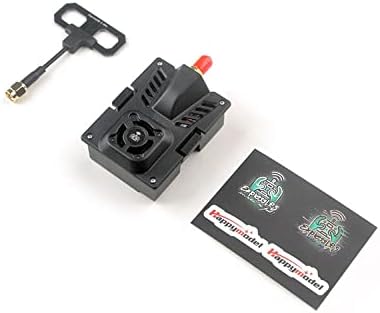
The HappyModel ES24TX Pro is an advanced 2.4GHz ExpressLRS (ELRS) Micro TX module designed for remote control transmitters. It offers a maximum output power of 1000mW, ensuring robust signal transmission. This module features a built-in cooling fan to maintain optimal operating temperatures during high-power use and an RGB LED for status indication. It is compatible with most OpenTX radio transmitters equipped with a Micro JR bay, including popular models like the TX16S, QX7, TX12, and X9D. The module comes pre-installed with ExpressLRS firmware for plug-and-play functionality.
Image 1: HappyModel ES24TX Pro Micro TX Module with antenna connector.
2. Likarolo tsa lihlahisoa
Matla a Sehlahisoa se Phahameng: Up to 1000mW for extended range and signal reliability.
Fan e Pholileng e Kopantsoeng: Ensures stable performance by preventing overheating during high-power operation.
RGB LED Module: Provides visual status feedback.
Bophara ba Tšebelisano: Supports OpenTX radio transmitters with a Micro JR bay (e.g., TX16S, QX7, TX12, X9D).
Pre-installed ExpressLRS Firmware: Ready for immediate use upon installation.
Compact Micro TX Form Factor: Designed for easy integration into compatible radio transmitters.
3. Se ka Lebokoseng
Pakete hangata e kenyelletsa likarolo tse latelang:
HappyModel ES24TX Pro Micro TX Module
Antenna
Stickers (may vary)
Image 2: Contents of the HappyModel ES24TX Pro package, including the module, antenna, and stickers.
4. Litlhaloso
Sebopeho
Tlhaloso
Nomoro ea Mohlala
ES24TX Pro
Matla a Phahameng ka ho Fetisisa
1000mW
Khafetsa
2.4GHz (ExpressLRS)
Ho phodisa
Fan e hahelletsoeng e futhumatsang
Sesupo sa Boemo
RGB LED module
Ho lumellana
OpenTX radio transmitters with Micro JR bay (e.g., TX16S, QX7, TX12, X9D)
Pre-installed Firmware
ExpressLRS
Boima ba Ntho
3.2 lik'hilograma
Litekanyo tsa sephutheloana
5.63 x 4.37 x 2.44 lisenthimithara
5. Litaelo tsa ho seta
5.1 Ho Kena ka Sebele
Ensure your radio transmitter is powered off.
Locate the Micro JR bay on the back of your compatible OpenTX radio transmitter (e.g., TX16S, QX7, TX12, X9D).
Carefully insert the ES24TX Pro module into the JR bay, ensuring it is seated firmly.
Attach the provided antenna to the SMA connector on the module. Hand-tighten only; do not overtighten.
Image 3: The ES24TX Pro module correctly installed in the JR bay of a compatible radio transmitter.
5.2 Radio Transmitter Configuration
Power on your radio transmitter.
Navigate to the Model Setup menu in OpenTX/EdgeTX.
Scroll to the "External RF" section.
Set the External RF mode to "CRSF" (Crossfire) as ExpressLRS uses the CRSF protocol.
Ensure the internal RF module is turned off if you are using the external ELRS module exclusively.
5.3 Firmware Flashing (Advanced Users)
While the module comes with pre-installed ExpressLRS firmware, advanced users may wish to update or flash custom firmware. This typically involves:
Accessing internal switches: Some users report needing to open the module casing to access internal switches for flashing. Refer to community resources or HappyModel documentation for specific instructions for your module version.
Connecting via USB-C: The module features a USB-C port for firmware updates.
Using the ExpressLRS Configurator: Download the latest ExpressLRS Configurator software to compile and flash firmware.
Setšoantšo sa 4: Ka hare view of the ES24TX Pro module, showing the heatsink and potential access points for advanced configuration.
6. Litaelo tsa Ts'ebetso
6.1 Ho Tlama ho Moamoheli
To establish a connection between the ES24TX Pro module and an ExpressLRS receiver:
Ensure both the TX module and the receiver are powered on.
Put the receiver into binding mode (typically by cycling power three times or pressing a bind button). The receiver's LED will usually flash rapidly.
On your radio transmitter, navigate to the ExpressLRS LUA script (usually found in the Tools menu).
Select the "Bind" option within the LUA script. The TX module's RGB LED will indicate binding status.
Once bound, the receiver's LED should become solid, and the TX module's LED will indicate a successful connection.
6.2 Ho Fetola Tlhahiso ea Matla
The ES24TX Pro supports adjustable power output up to 1000mW. Adjusting power is crucial for optimal performance and to prevent overheating.
Access the ExpressLRS LUA script on your radio transmitter.
Locate the "Power" or "TX Power" setting.
Select the desired power level (e.g., 10mW, 25mW, 100mW, 250mW, 500mW, 1000mW).
For indoor flying or short ranges, lower power settings (e.g., 100mW) are often sufficient.
For outdoor flying or longer ranges, higher power settings (e.g., 250mW or above) may be used.
Bohlokoa: When using higher power settings, ensure the built-in cooling fan is active to prevent overheating. The fan can usually be enabled or configured within the LUA script.
6.3 RGB LED Status Indicators
The RGB LED on the module provides visual feedback on its operational status. Refer to the official ExpressLRS documentation for a complete list of LED patterns and their meanings. Common indications include:
Botala bo tiileng: Connected and operating normally.
Botala bo Khanyang: Binding mode or waiting for connection.
Bokhubelu bo tiileng: Error or fault condition.
Bofubelu bo Benyang: Overheating warning or low voltage.
7. Tlhokomelo
Boloka Hloekile: Regularly clean the module and its connectors with a soft, dry cloth. Avoid using liquids or harsh chemicals.
Tlhokomelo ea Antenna: Ensure the antenna is securely attached before each use. Avoid bending or stressing the antenna excessively.
Feni e Pholisang: Periodically check the cooling fan for dust or obstructions. A blocked fan can lead to overheating.
Polokelo: Boloka mojule sebakeng se omileng, se pholileng hole le khanya ea letsatsi le mocheso o feteletseng.
Lisebelisoa tsa Firmware: While not strictly maintenance, keeping the firmware updated can improve performance and add new features. Refer to the ExpressLRS project for the latest firmware and update procedures.
8. Ho rarolla mathata
8.1 Module Not Powering On / No LED
Sheba Khokahano: Ensure the module is fully seated in the JR bay of your radio transmitter.
Radio Power: Verify that your radio transmitter is powered on and has sufficient battery charge.
Radio Configuration: Confirm that the external RF module is enabled in your radio's model settings.
Module Fault: If the module previously worked and now shows no signs of life, it might be faulty.
8.2 Unable to Bind to Receiver
Firmware Mismatch: Ensure both the TX module and the receiver are running compatible ExpressLRS firmware versions. It is recommended to use the same major version.
Binding Phrase: If using a binding phrase, ensure it is identical on both the TX module and the receiver.
Mokhoa oa ho Tlama: Double-check that you are following the correct binding procedure for both the receiver and the TX module (e.g., power cycling the receiver correctly).
Haufi: Keep the receiver close to the TX module during the binding process.
8.3 Module Overheating
Enable Fan: Ensure the built-in cooling fan is enabled and operating, especially when using higher power output settings (250mW and above). This can usually be configured via the ExpressLRS LUA script.
Ho foka ha moea: Ensure the fan intake and exhaust vents are not obstructed.
Tlhophiso ea Matla: Reduce the TX power output if overheating persists, especially in warm environments or during prolonged use.
8.4 Intermittent Connection / Range Issues
Tlhahlobo ea Antenna: Verify that the antenna is securely connected to the module and is not damaged.
Sebaka sa Moamoheli: Ensure the receiver antenna(s) on your drone/aircraft are properly positioned and not obstructed by carbon fiber or other components.
Motlakase: Increase the TX power output if operating at longer ranges, ensuring the cooling fan is active.
Tikoloho: Be aware of potential interference from Wi-Fi, other 2.4GHz devices, or physical obstructions in your flying area.
9. Tiisetso le Tšehetso
For warranty information and technical support, please refer to the official HappyModel website or contact your retailer. Specific warranty terms may vary by region and point of purchase. It is recommended to retain your proof of purchase for any warranty claims.
For general ExpressLRS information, firmware, and community support, visit the official ExpressLRS project websebaka.
Ask about setup, troubleshooting, compatibility, parts, safety, or missing instructions. Manuals+ will review the question and use this page’s manual context to help answer it.