
1. Selelekela
This manual provides detailed instructions for the proper installation, operation, and maintenance of your Lanzar RBHTG414 Heritage 600 Watt 4-Channel MOSFET Amplifier. To ensure optimal performance and safety, please read this manual thoroughly before attempting to install or operate the ampmoqhobi. Boloka bukana ena bakeng sa tšebeliso ea nako e tlang.
2. Litaelo tsa Tšireletso
Kamehla ela hloko mehato e latelang ea tšireletso nakong ea ho kenya le ho sebetsa:
- Disconnect the vehicle's negative battery terminal before beginning any installation work to prevent electrical shorts.
- Ensure all wiring is properly routed and secured to prevent damage from sharp edges or moving parts.
- Use appropriate gauge wiring for power and ground connections as specified in the installation section.
- Kenya le amplifier sebakeng se lumellang moea o lekaneng ho thibela ho chesa haholo.
- Qoba ho phahamisa amplififier libakeng tse pepesehetseng mongobo kapa ho thothomela ho feteletseng.
- U se ke ua leka ho lokisa kapa ho fetola amplifier yourself. Refer all servicing to qualified personnel.
3. Sehlahisoa Overview
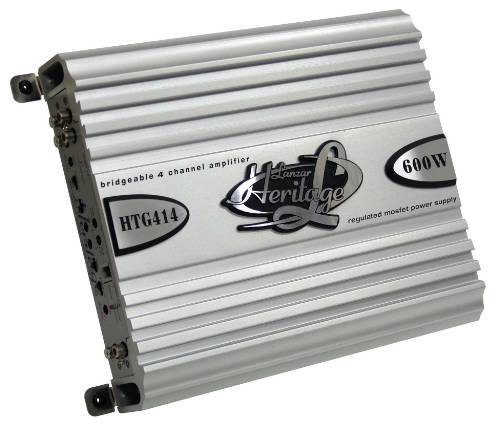
The Lanzar RBHTG414 Heritage amplifier is a 600 Watt, 4-channel MOSFET amplifier designed to deliver powerful and clear audio performance for your car audio system. It features a regulated MOSFET power supply and is bridgeable, offering flexible configuration options for various speaker setups.
4. Ho seta le ho kenya
Ho kenya hantle ho bohlokoa bakeng sa ts'ebetso le bophelo bo bolelele ba hau amplifier. The Lanzar RBHTG414 is designed for surface mounting.
4.1 Lethathamo la Pele la ho kenya
- Ensure you have all necessary tools and wiring kits (power wire, ground wire, remote turn-on wire, RCA cables, speaker wire, fuses, terminals).
- Choose a mounting location that is dry, well-ventilated, and secure.
- Plan your wiring routes to avoid interference and potential damage.
4.2 Mahokelo a Wiring
The following outlines general wiring procedures. Consult a professional installer if you are unsure about any steps.
- Power Connection (BATT+): Connect a heavy-gauge power cable (e.g., 8-gauge or 4-gauge depending on total system power) directly from the vehicle's positive battery terminal to the amplifier's BATT+ terminal. Install an in-line fuse holder within 18 inches (45 cm) of the battery.
- Khokahano ea fatše (GND): Connect a heavy-gauge ground cable of the same length as the power cable from the amplifier's GND terminal to a clean, unpainted metal surface on the vehicle's chassis. Ensure a solid, low-resistance connection.
- Remote Turn-On (REM): Connect a smaller gauge wire (e.g., 18-gauge) from the amplifier's REM terminal to the remote turn-on output of your head unit. This wire signals the amplifier ho bulela le ho tima ka sistimi ea molumo ea koloi ea hau.
- RCA Input Connections: Connect RCA audio cables from your head unit's pre-amp lihlahisoa ho amplifier's RCA input jacks. For 4-channel operation, use two pairs of RCA cables (Front L/R, Rear L/R).
- Lihokelo tsa Sebui: Connect your speakers to the ampli-terminals tsa tlhahiso ea sebui sa lifier.
- 4-Channel Stereo Mode: Connect each speaker to its corresponding channel output (e.g., Front Left speaker to CH1+, CH1-, Front Right to CH2+, CH2-, etc.).
- Bridged Mode (2-Channel): For higher power output to subwoofers or a pair of speakers, the RBHTG414 can be bridged. Refer to the amplifier's terminal markings for specific bridged connection points (typically CH1+ and CH2- for one bridged channel, and CH3+ and CH4- for the second). Ensure your speakers are rated for the increased power output in bridged mode.
4.3 Ho hloella
Ka mokhoa o sireletsehileng thaba amplifier to a solid surface using appropriate screws. Ensure there is sufficient space around the amplifier for air circulation, especially around the heat sink fins, to prevent thermal shutdown.
5. Litaelo tsa Ts'ebetso
Hang ha e kentsoe, the amplifier will turn on automatically with your head unit. Adjustments should be made carefully to achieve optimal sound quality.
- Fumana Taolo: The gain control matches the amplifier's input sensitivity to the output level of your head unit. Start with the gain set to minimum, then slowly increase it until you hear distortion, then back off slightly. This is not a volume control.
- Litlhophiso tsa Crossover: Haeba u amplifier includes crossover controls (e.g., High-Pass Filter (HPF), Low-Pass Filter (LPF)), adjust them according to your speaker type. HPF is used for full-range speakers to block low frequencies, while LPF is used for subwoofers to block high frequencies.
- Bass Boost: Use the bass boost feature sparingly, if available, as excessive boosting can lead to distortion and potential speaker damage.
6. Tlhokomelo
Regular maintenance helps ensure the longevity and performance of your ampmoqhobi.
- Ho hloekisa: Nako le nako hloekisa amplifier's exterior with a soft, dry cloth. Ensure the heat sink fins are free of dust and debris to maintain proper cooling.
- Lihokelo: Occasionally check all wiring connections for tightness and corrosion. Loose connections can cause poor performance or damage.
- Moea oa moea: Etsa bonnete ba hore amplifier's mounting location remains clear of obstructions that could impede airflow.
7. Ho rarolla mathata
Haeba u e-na le bothata le uena amplifier, refer to the following common problems and solutions before seeking professional service.
| Bothata | Lebaka le ka khonehang | Tharollo |
|---|---|---|
| AmpLifier ha e bulele | Blown fuse; loose power/ground/remote wire; no power from head unit remote output. | Check in-line fuse and amplifier fuses; verify all power, ground, and remote connections are secure; test remote wire for 12V when head unit is on. |
| Ha ho tlhahiso ea molumo | Loose RCA cables; incorrect gain setting; speaker wires disconnected; amplifier ka mokhoa oa tšireletso. | Check RCA connections at both amplifier and head unit; ensure gain is set correctly; verify speaker wire connections; check for protect light indicator. |
| Molumo o sothehileng | Gain set too high; improper crossover settings; damaged speaker; poor ground connection. | Reduce gain setting; adjust crossover filters; inspect speakers for damage; ensure ground connection is solid. |
| Ampho chesa haholo ka lifier | Insufficient ventilation; impedance mismatch; prolonged high-power operation. | Etsa bonnete ba hore moea o phalla o lekaneng ho potoloha amplifier; verify speaker impedance matches amplifier's rating; reduce volume or operating time. |
8. Litlhaloso
The following are key specifications for the Lanzar RBHTG414 Heritage Amplifereletsi:
- Brand: Lanzar
- Nomoro ea Mohlala: RBHTG414
- Palo ea Likanale:4
- Sehlahisoa sa Matla: 600 Watts (Peak)
- Ampsehlopha sa lifier: MOSFET
- Mofuta oa ho Beha: Thaba e kaholimo
- Litekanyo tsa Sehlahisoa (L x W x H): 2 x 2 x 2 lisenthimithara
- Boima ba Nthoboima: 10.89 lik'hilograma
- UPC:068888725088
- Mmala: BLACK (Unit shown in image is silver, but product data indicates BLACK)
9. Tiisetso le Tšehetso
Lanzar products are designed for reliability and performance. For information regarding warranty coverage, technical support, or service, please refer to the warranty card included with your product or visit the official Lanzar website. Please have your model number (RBHTG414) and purchase information ready when contacting support.